
Finding Vienna Residents Carefully
Choose the first record by the information already in hand. The Wood County CAMA property search accepts an owner name or parcel address and is usually the quickest route from a house to its owner of record. A name-only question may fit the state voter-status tool, court portals, or a historical index. For an older address, directory volumes and newspapers are often more useful than a current roll. Keep the exact spelling, date, role, and source for every match.
Ownership and residence are not the same. A parcel card names an owner and may show a tax mailing address that differs from the Vienna situs address, the physical location assigned to the parcel. A voter result concerns a registered voter, not everyone at the home. Printed directories omit some people and years. These limits make a second source essential, especially when names are common.
- Search CAMA by address or owner, then save the parcel, account, deed book/page, and record year.
- Use the West Virginia voter-status lookup only when the required first name, last name, and date of birth are known.
- Follow a deed book/page or party name into the Wood County Clerk index. Check both grantor, the seller, and grantee, the buyer.
- For past households, ask the regional libraries or archives for the correct directory year and check nearby years for moves.
- When no portal exposes the needed record, send a narrow West Virginia Freedom of Information Act request to the office that created it.
Vienna Resident Record Keepers
Vienna does not maintain a single citywide household roll. Most useful records sit at the Wood County Courthouse in Parkersburg or in statewide systems. The Clerk preserves recorded transfers, liens, plats, marriages, wills, probate files, and vital holdings. The Assessor maintains current parcel and tax facts. Elections staff administer registration, while the Secretary of State provides the personal status check and data-request route. For address-by-address use of these sources, continue to the Vienna street directory.
Vienna Property Names and Addresses
The county CAMA form offers Owner Name, Parcel Address, Account Number, District, Map/Parcel, Property Type, Legal Description, and Deed Book/Page. Enter owner names as last name followed by first name, without a comma. When an address fails, shorten it and try the statewide Property Assessment search, which adds mailing-address, street, flood, building-year, value, sale, and prior-owner filters. Results can be exported as CSV, but a broad export is still an assessment list, not a household directory.
The parcel card separates the situs address from the owner's mailing address. Read both labels. It also connects the current assessment to the recorded instrument through deed book and page. The annual assessment may lag a recent transfer, so confirm a sale in the Clerk's recorded deed index before treating the displayed owner as current.
Open the Wood County CAMA search before reviewing its controls below.
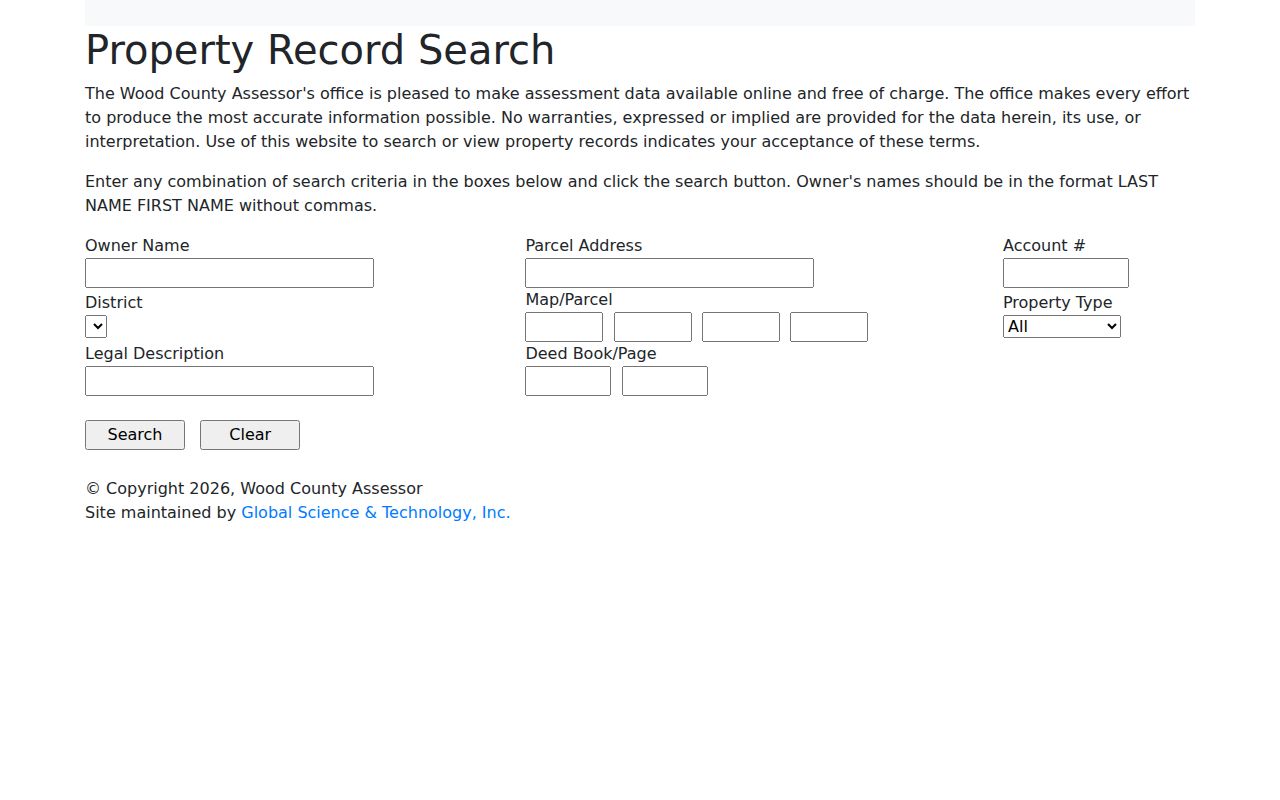
The form shown here supports both name and address routes, which makes it the practical first stop for a known Vienna parcel.
| Search field | Best use | Important limit |
|---|---|---|
| Owner Name | Find parcels held by a named owner | Use last name first; common names need another identifier |
| Parcel Address | Move from a street address to parcel facts | This is situs, not necessarily mailing address |
| Map/Parcel | Return to a known tax parcel | Assessment identifier, not a street number |
| Deed Book/Page | Bridge assessment and recorded deed | Read the deed for the legal transfer |
Wood County Deeds for Vienna
The Clerk's online system groups Deeds, Liens, Will/Misc, UCC, Marriage, Birth, Death, and other filings. A grantor is the party transferring property; a grantee receives it. Direct and reverse indexes offer two ways to follow those roles. Search a known name, then narrow with document type, book, page, legal description, map, or parcel. Save stable references instead of relying on a screenshot of a name.
Visit the Wood County index and imaging portal to see its record groups.

The visible group, sub-index, type, and book controls help distinguish a deed from a lien, will, marriage entry, or other filing. The public help does not state a complete online-image cutoff. Deeds and liens are held from 1799 to the present, but older or unscanned material may require the courthouse, off-site books, microfilm, or the West Virginia State Archives.
Use the record date. Compare the assessment year, deed recording date, voter-data update, directory year, and newspaper date. They do not describe one shared moment.
Current Vienna Resident Sources
Modern public systems list people only in defined roles. Property tools list owners. Deed indexes list parties to recorded instruments. The voter tool confirms the registration of the person entering the required private details. Vienna's municipal directory lists staff contacts, not city residents. Friends of Vienna provides civic context but no public member list. Select the roll that matches the question rather than blending them into a guessed household.
| Source | Who It Lists | Keeper | Access |
|---|---|---|---|
| Wood County assessment roll | Owners of taxable parcels | County Assessor | Free CAMA and state searches |
| Voter status and lists | Registered voters | Secretary of State and County Clerk | Personal lookup or regulated request |
| Recorded-document index | Parties to deeds, liens, wills and filings | Wood County Clerk | Free index; copies may cost |
| Vienna staff directory | Municipal officials and employees | City of Vienna | Free online |
| Business entity search | Agents, officers and organization records | West Virginia Secretary of State | Free details; some exports paid |
A person may appear in several roles without living at the address shown. An entity agent address, property mailing address, or old directory entry needs its own date and label. The Vienna resident lookup sets out a one-name verification sequence and explains why a second record matters.
Vienna Voter Record Limits
The official status lookup requires first name, last name, and date of birth. It can return registration status, party, districts, and polling place, with data updated nightly. It is designed for a voter checking a registration, not for open browsing by street. West Virginia Code §3-2-30 separately permits supervised inspection of voter records and lists fields that may be supplied through a formal data request, subject to fees and statutory limits.
Review the Secretary of State's voter-status form and its required fields.
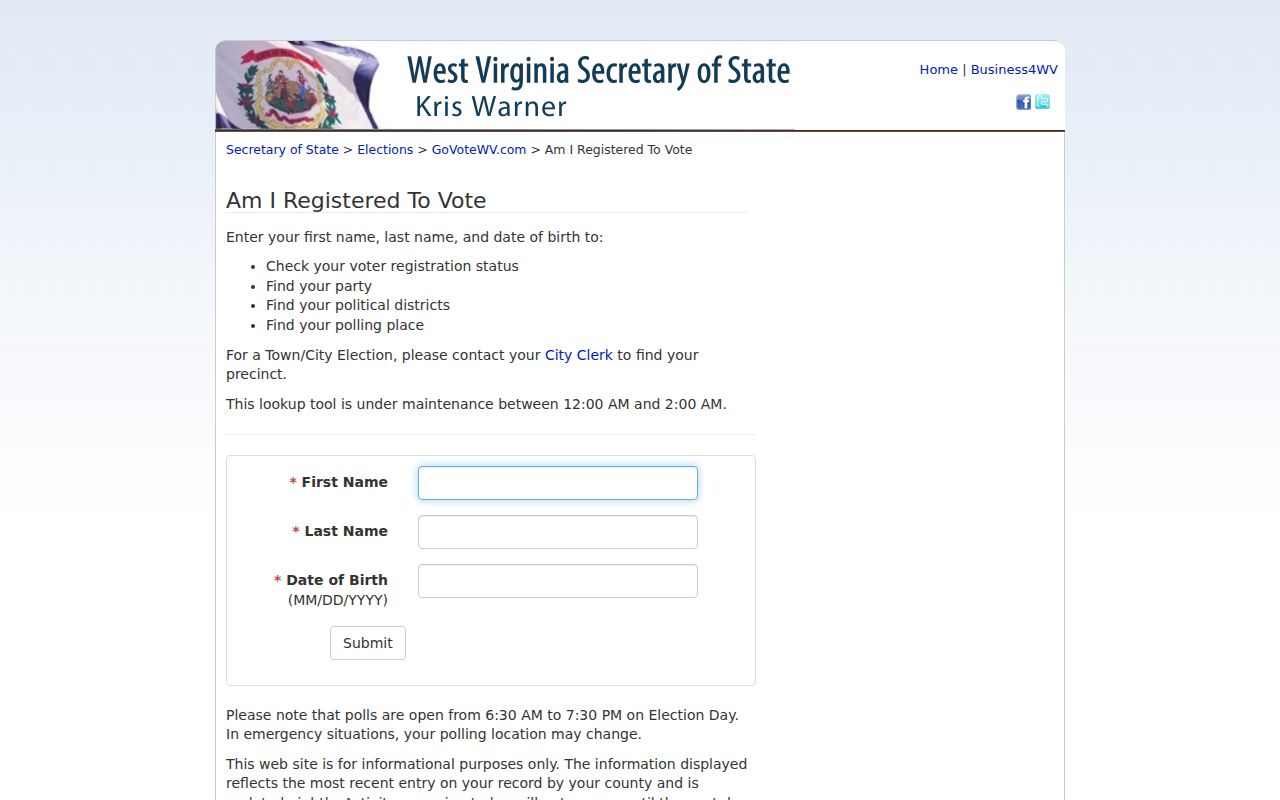
The date-of-birth requirement shown on the form helps prevent a loose name search from being treated as proof. A public list request is a different access channel and must follow the stated purpose, format, delivery, and payment rules.
Respect protected addresses. West Virginia's Address Confidentiality Program supplies a substitute address to qualifying survivors. Do not try to uncover a participant's actual location or use any public record to stalk, harass, or threaten a person.
Vienna Names Beyond Property
Court and vital sources answer different questions. WVPASS covers public circuit documents back to 1999 and uses an account, while the separate magistrate search accepts a first name, last name, or case number and caps results at 30. Sealed and juvenile records are unavailable. A court name match shows a party in a case, not a current home. Confirm the county, case number, role, and disposition with the clerk.
Historical birth, death, and marriage indexes can help distinguish relatives. West Virginia Code §16-5-27 keeps births confidential for 100 years and deaths, fetal deaths, marriages, divorces, and annulments confidential for 50 years. Eligible certificate requests go through state Vital Registration or the county clerk, with identification and relationship rules. The public historical birth search supports name, county, year range, and exact or pattern matching.
The Secretary of State advanced business search is useful when a Vienna address belongs to a company. It filters by city, county, status, type, dates, purpose, and ownership. Treat an agent or officer address as a business filing fact, not a residential claim.
Historical Vienna Resident Directories
Older Vienna research often begins in collections labeled for Parkersburg or Wood County. Cataloged Parkersburg city directories include Vienna-area households, but the run contains missing years and should never be described as continuous. Search a named person in the year closest to the event, note the address and occupation exactly as printed, then compare the prior and next available volumes. The full shelf and entry method belongs in the Vienna city directory.
The Parkersburg & Wood County Public Library accepts remote genealogy requests at parkwoodgen@parkwoodlib.com and maintains regional newspapers and microfilm. Its genealogy service is a discovery route when a volume is not online. The Wood County Historical and Preservation Society operates the Phelps-Tavenner Research Center and Resource Barn at 2401 Camden Avenue, while the State Archives supplies county microfilm, maps, histories, and indexes.
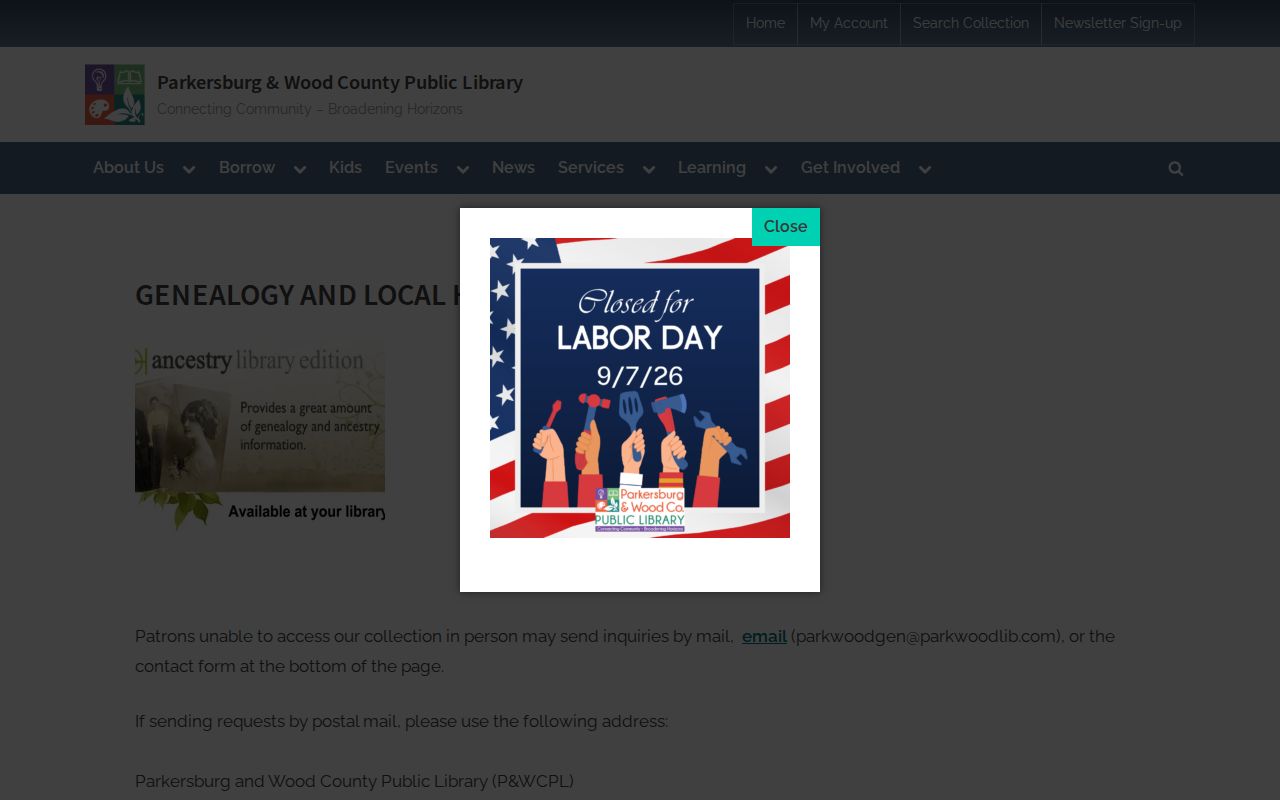
The service shown provides a practical fallback for directory and newspaper material that cannot be searched from home.
Vienna Boundaries Change Searches
Vienna incorporated in 1935, and the 1950 Census report records the 1949 annexation of parts of Parkersburg and Williams districts. That shift is a common historical trap. An older deed, census line, directory, or newspaper item may use a district or nearby place name for land now read as Vienna. Search the earlier jurisdiction and compare the legal description, plat, map, and neighboring owners before rejecting the result.
Modern boundaries also differ. ZIP 26105 describes mail delivery, E-911 assigns a physical address, the Assessor records a situs, and the city line sets municipal jurisdiction. The state parcel viewer is an assessment visualization, not a legal survey. A Vienna mailing label alone does not prove that land falls within city limits. This matters when requesting city permits, county compliance files, or an ordinance record.
Local history adds useful search terms. Vienna's official account ties the name to Joseph Spencer's 1794 land grant and Vienna, New Jersey. The electric railway, Vitrolite production into the 1940s, Grand Central Avenue, Spencer's Landing, and the former Johns Manville site can improve a newspaper or archive search when a street address changed or OCR missed a name.
Requesting Unposted Vienna Records
Some records have no public address index. Vienna's online archive searches budgets, newsletters, CDBG materials, storm-water reports, utility documents, and other city files by keyword, type, and date. Those records may name officials, contractors, board appointees, or public commenters as context, but the archive is not a resident roll. No public Vienna permit or municipal citation results portal was located.
Use the West Virginia Freedom of Information Act, W.Va. Code §29B-1-1 et seq., when the record exists but is not posted. Address the request to the office that created it. Give a street address or parcel number, a narrow date range, and a document type. Ask to inspect existing records or receive copies; do not ask the office to create a new resident list. City building and code records begin with Vienna departments, while county permits and compliance records can be requested from the office at 911 Core Road, 304-424-1988.
For Clerk material, in-person access remains important. Deeds and liens are on the first floor of the courthouse; birth, death, and probate holdings occupy designated rooms, and elections or marriage functions are on the fourth floor. The Clerk does not perform title searches. Researchers may inspect indexes and books themselves, request a defined copy, or hire a title professional for a formal chain.