
Vienna Directory Years on Record
Vienna city directory research begins with Parkersburg regional volumes. The Gale United States City Directories reel list specifically marks Vienna in several Parkersburg runs. That catalog is the best proof that Vienna was included, but it does not mean every household appears or every volume is free online. WVU lists broader Parkersburg runs, while the West Virginia State Archives holds uneven state gazetteers. Record the catalog, reel, volume year, and page used.
| Vienna collection | Cataloged span | Repository | How to consult it |
|---|---|---|---|
| Parkersburg directories naming Vienna | 1914-1960, in uneven runs | Gale/Cengage catalog and regional libraries | Catalog proof; scans may need a library or subscription |
| Later Parkersburg city directories | 1925-1985, overlapping reels | WVU Regional History Center | Microfilm; confirm Vienna volume by volume |
| West Virginia State Gazetteers | 1877-1924, with gaps | West Virginia State Archives | Reference collection |
| Regional newspapers | 1872-2023, two titles | Kothe Memorial archive | Free OCR and date search |
The Vienna runs have many known gaps. The 1914-1919 group lacks 1915, 1917, and 1918. Later groups omit 1922, 1923, 1927, 1931, 1941, 1945, and 1953. Vienna is named in entries spanning 1951-1960, but no official source gives a final Vienna-specific print year. A missing volume is not proof that a person left town. It means the next source must be a census, newspaper, deed, or another dated roll.
Why Vienna Appears Under Parkersburg
Historic publishers grouped nearby places to form one useful market area. Vienna therefore appears inside Parkersburg city directories rather than always receiving a stand-alone title. The Library of Congress directory guide notes that nearby communities often share a volume. Check the cover, contents, community heading, and page header before deciding Vienna is absent.
Local history explains the regional label. Vienna grew north of Parkersburg along the Ohio River and did not incorporate until 1935. Roads and an electric railway tied the Parkersburg-Marietta corridor together. A publisher could use a regional title while keeping a distinct Vienna subsection. Search both place names, and try Grand Central Avenue or another known street when a catalog description is brief.
Boundary changes add one more trap. A federal census report records annexation of parts of Parkersburg and Williams districts in 1949. An older listing may name a district that is now read as Vienna. That is a geography change, not a contradiction.
Note: An explicit missing year is a real limit, not a blank that should be filled by assuming continuous annual publication.
Vienna Libraries Open the Shelf
The Vienna Public Library at 2300 River Road is the closest local reference point. Its Library Commission profile describes a West Virginia history and regional information collection, though it does not publish a year-by-year directory inventory. Call 304-295-7771 before visiting and ask staff to confirm the exact volume, format, and access rules.
The Parkersburg and Wood County Public Library genealogy service is the stronger remote route. Researchers may email parkwoodgen@parkwoodlib.com or mail a request to 3100 Emerson Avenue, Parkersburg, WV 26101, Attention: Genealogy. The listed minimum research fee is $2, copies cost $0.10 per page, and the service caps a submission at five requests. For newspaper work, give a month and year. A tight request should name the person, suspected Vienna address, and one city directory year.
The Vienna library began through the Vienna Woman's Club in 1954, became a city library in 1973, and moved to its current building in 1976. Those dates guide searches for civic news and local collection notes. They also make the library's own story part of Vienna's directory history.
The genealogy page shows the regional research entry point used for directory questions. Its service details help a Vienna researcher form a request before writing or visiting.
Use the current library page to verify costs and limits, since a catalog citation alone does not promise that staff can copy a particular reel.
Vienna History Beyond Directory Reels
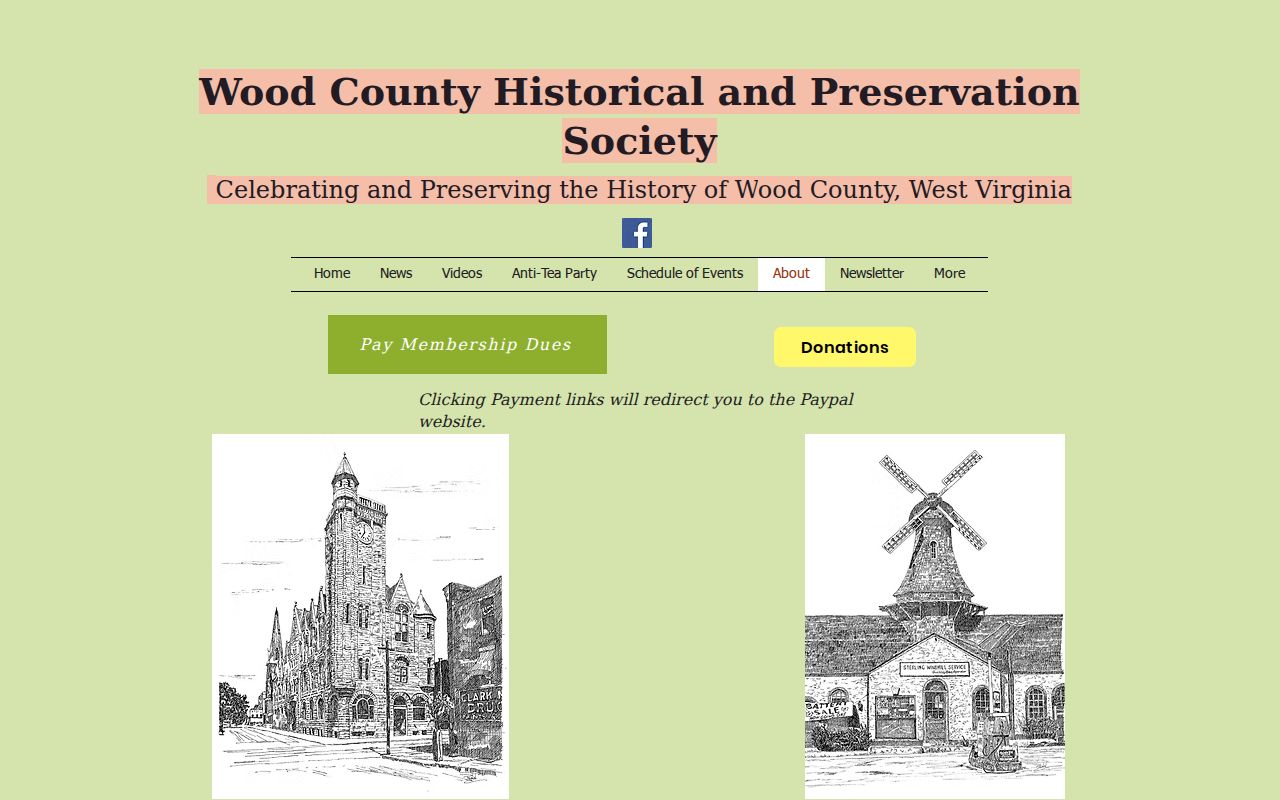
The Wood County Historical and Preservation Society operates the Phelps-Tavenner Research Center and Resource Barn at 2401 Camden Avenue in Parkersburg. The center occupies a circa-1800 house described as Wood County's oldest. Its genealogy and local-history material is available Wednesdays from 9 a.m. to 1 p.m. and by appointment. Ask about community files, maps, and family folders that might explain a directory entry.
The society's own page introduces the research center and its holdings. This physical collection is valuable when a Vienna city directory reel gives only a terse name, street, or trade.
The State Archives Wood County page points to a 1980 county history, its 1983 index, community histories, maps, post-office history, clippings, and reports on preserved county books. These aids supply context when a surname is common or an address changed jurisdiction. The preserved number-one marriage book shows why a printed directory is only one layer in Wood County's long record trail.
Read a Vienna Directory Listing
No public full-page Vienna scan was reachable during the research pass, so a made-up entry would mislead. Use this catalog-backed field inventory when a reel or scan is opened. Photograph the page header, entry, nearby lines, and abbreviation key. Those details establish the city directory year and prevent a short code from being expanded incorrectly.
| Printed name | Surname, given name, and sometimes a spouse or household note |
|---|---|
| Work line | Occupation and, in some editions, an employer |
| Street line | House number, street, and a residence or boarding code |
| Status mark | Owner, renter, or widow notation only when that volume defines it |
| Citation | Directory year, page, section heading, volume or reel, and image reference |
- Criss-cross directory
- A street-order section that lists addresses first, then the names printed at each address.
- Householder index
- An index organized around a household head or address rather than every person in a family.
- Abbreviation key
- The volume's own legend for short forms. Save it because codes can change between publishers and years.
An entry shows what a compiler printed for that edition. It does not prove ownership or year-round occupancy. Compare the street line with a deed or assessment record, and treat an occupation as historical context rather than a current fact.
Vienna Names in Regional Newspapers
The Kothe Memorial newspaper archive can bridge directory gaps. It contains 26,900 pages of the Parkersburg Eclipse from 1872-1969 and 41,210 pages of the Eclipse News Review from 1969-2023. Search by person, place, event, decade, and date. Try a surname with Vienna, a street, Vitrolite, or a civic landmark.
OCR is imperfect. Old type, narrow columns, and faded scans can hide a clear printed name. Search spelling variants and a street without the house number. Obituaries, estate notices, public notices, club items, and business announcements may explain why a person appears, moves, or vanishes from a Vienna city directory. Save the newspaper title, date, page, and image alongside the directory citation.
The scale is useful, but it can also overwhelm. A city directory narrows the likely year and address first; the newspaper then supplies narrative detail. Neither source alone proves a recorded ownership transfer.
Vienna Records Around Directories
The West Virginia Archives microfilm description fills eras that city directories do not. Wood County holdings include marriages from 1801-1969, wills from 1800-1969, deeds from 1802-1901, and a deed index from 1798-1969. Birth, death, order, entry, surveyor, and naturalization runs have their own spans and gaps. Use their stated dates, not a guess that every year survives.
WVU's Wood County collection A&M 0458 contains clerk material from 1785-1935 in 166.5 linear feet and 216 microfilm reels. Inventories, wills, appraisements, estate settlements, and bills of sale can distinguish relatives who share a name. FamilySearch separately catalogs Wood County land books from 1802-1900 on 16 reels, though account or affiliate access may apply.
| Period | Vienna research route | Best contribution |
|---|---|---|
| Late 1700s to 1900 | Clerk records, land books, archive reels | Estate, land, and family links |
| 1914 to 1960 | Vienna-including regional directories | Dated names, streets, spouses, and trades |
| Later twentieth century | WVU reels and newspapers | Regional continuity and public notices |
Note: Archive coverage and city directory coverage overlap, but each collection must be cited under its own title and stated dates.
Vienna Directory Timeline Clues
Vienna's growth changed how names were labeled. Vienna incorporated in 1935. The 1949 annexation altered the municipal context of some older addresses. These milestones can explain why a stable place appears under a new heading.
- 1914: the first cataloged Parkersburg run in the research that notes Vienna begins, with gaps soon after.
- 1935: Vienna incorporates, adding a clear municipal name to later records.
- 1949: annexed district portions create a boundary clue for old addresses.
- 1951-1960: several catalog descriptions expressly name Vienna, though 1953 is missing.
- 1985: WVU's broader Parkersburg microfilm runs extend to this year; inclusion needs checking volume by volume.
Vitrolite production into the 1940s and the electric railway are strong search terms in local papers. They can connect a terse trade or employer code to Vienna's industrial story. Joseph Spencer's early land grant and the Vienna, New Jersey, naming story add older terms for county-history searches.
Trace Family Through Vienna Directories
City directories can fill the long space between federal census dates. Start with one Vienna name and a likely year. Follow each appearance, but preserve the exact spelling and address printed. A new spouse notation, trade, street, or absence becomes a question to test elsewhere rather than a conclusion by itself.
- Find the earliest cataloged year near the known event, then search the surname and common spelling variants.
- Move one available volume at a time. Note every change in street, spouse notation, and occupation.
- Check the address-order section when present. Neighboring names can distinguish two same-name households.
- Pair the directory line with the nearest census, deed index, or land book instead of treating it as ownership proof.
- Close a disappearance with a newspaper obituary, estate file, marriage record, or later directory in another place.
A missing name can mean a move, death, omission, publication gap, or change in who was listed as householder. The Vienna resident lookup offers modern verification paths, while current address-keyed work belongs in the Vienna street directory. Keep historical evidence separate from current contact data.